- +91 7701934257

- +91 7701934257
Professional Packers and Movers vs Local Labour
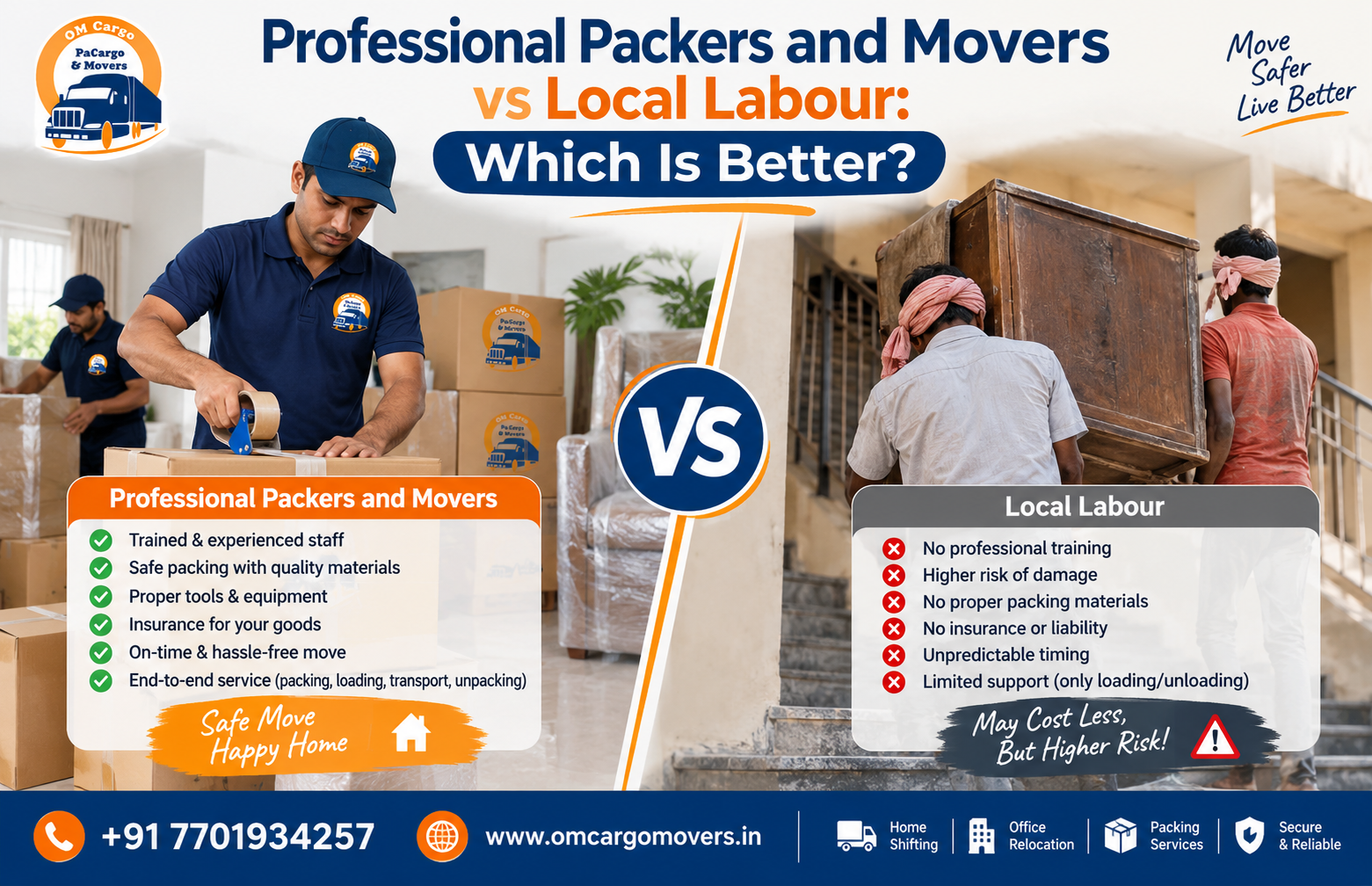
Professional Packers and Movers vs Local Labour: Which Is Better?
Moving day usually starts the same way everywhere. You look at your house, then at the number of boxes you actually own, and a small voice asks: do I really need packers and movers, or can two labourers from the corner and a tempo handle this?
It’s a fair question. Local labour costs less on paper. Professional packers and movers cost more on paper. But paper doesn’t carry your grandmother’s crockery down three flights of stairs, and it definitely doesn’t show up four hours late on moving day.
Here’s an honest breakdown of professional packers and movers vs local labour, based on real consumer-protection rules and how the industry actually works — not guesswork.
What Do We Mean By “Local Labour”?
Local labour usually means hiring a mazdoor or two, along with a tempo or mini-truck, directly from a labour chowk or through a local contact. There’s no company name, no invoice, and often no fixed number to call if something goes wrong.
You pack everything yourself. You supply your own cartons, tape, and newspaper. The labourers only load, carry, and unload.
This setup works fine for a single bed and a few bags. It gets shaky the moment a washing machine, a glass dining table, or a full 2 BHK worth of furniture enters the picture.
What Do Professional Packers and Movers Actually Do?
A full-service company handles the whole relocation as one job: packing, loading, transportation, unloading, and unpacking. Many, like Om Cargo Movers’ home shifting service, also offer furniture dismantling, car and bike transportation, and short-term warehousing and storage.
The packing itself uses corrugated boxes, bubble wrap, thermocol sheets, and wooden crating for items like TVs and mirrors. Trained staff know which items go where in the truck so nothing shifts during transit.
That’s the core difference. Local labour moves your goods. A professional mover manages your move.
Professional Movers vs Local Labour: Quick Comparison
| Factor | Local Labour | Professional Packers and Movers |
|---|---|---|
| Upfront cost | Lower quote | Higher quote, but usually all-inclusive |
| Packing material | You buy and supply it | Included — boxes, bubble wrap, crating |
| Who packs | You do it yourself | Trained crew packs the whole house |
| Damage risk | Higher — no packing expertise | Lower — item-specific packing methods |
| Insurance | None | Transit insurance usually available |
| Paper trail / invoice | Rarely any | GST invoice, written estimate |
| Legal accountability | None — informal arrangement | Covered under the Carriage by Road Act |
| Your time involved | High — you pack, label, supervise | Low — crew handles it, you supervise |
| Best suited for | Short, small, low-value moves | Full homes, offices, intercity moves |
Cost Comparison: Cheaper Isn’t Always Cheaper
Local labour wins on the quote you see first. A two-hour loading job with a tempo can genuinely cost less than a full-service move.
But add up what usually happens next: you buy cartons and tape from the market at retail price, you take a day off work to pack everything yourself, and if a mirror or TV panel cracks in transit, you pay for the replacement out of your own pocket.
Professional packers and movers quote a slightly higher number, but it usually includes packing material, labour, transport, and often insurance. One bill instead of five surprise expenses. You can see how this plays out in practice by comparing sample intercity moving charges against what local labour plus your own time and material would cost.
So the real comparison isn’t “cheap vs expensive.” It’s one predictable cost against several unpredictable ones.
Safety of Your Belongings
This is where the gap widens the most. Local labourers are strong and hardworking, but packing fragile items isn’t their job — carrying them is.
Professional movers train their teams specifically for packing glassware, electronics, artwork, and appliances, using item-specific materials: bubble wrap for glass, anti-static wrap for electronics, foam corners for furniture edges.
A sofa will survive local labour just fine. A television, a dining set, or a wardrobe mirror is a different story.
Time and Convenience
With local labour, you’re the project manager. You buy the material, pack every box, label it, and coordinate the loading yourself. It eats up a weekend, sometimes annual leave.
With professional packers and movers, you supervise instead of sweat. The crew arrives with material, packs the house in a few hours, and you’re free to handle other move-related admin — school transfers, address updates, or just resting before the new place demands unpacking too.
If your time has any value at all, that convenience is worth counting as a real saving, not a luxury.
Accountability, Insurance, and the Law
Here’s the part most people skip until something goes wrong.
Under India’s Consumer Protection Act, 2019, consumers have the right to clear information about the service they’re paying for, including insurance coverage and terms. If a mover misleads you about what’s covered, you have legal grounds to complain.
Registered packers and movers are also treated as common carriers under the Carriage by Road Act, 2007, which makes them legally responsible for loss or damage to goods in their custody during transit.
Local labour, being an informal arrangement, sits outside most of this framework. No invoice, no GSTIN, no insurance policy — no one to hold accountable if your fridge shows up dented.
If a dispute does happen with a registered mover, you can approach the National Consumer Helpline (1800-11-4000 or 14404) or file online through the e-Daakhil portal, and you have two years from the date of the dispute to do so. That safety net doesn’t exist with informal labour.
One thing worth checking before you pay anyone: ask for the actual insurance policy copy, not just a receipt saying “insurance included.” Genuine transit insurance is issued by a registered insurer and regulated by the IRDAI — a verbal promise from a mover isn’t the same thing. It’s also worth running through a proper fraud-prevention checklist before you hand over any advance.
When Local Labour Actually Makes Sense
Local labour isn’t always the wrong call. It works well when:
- You’re moving within the same building or a very short distance.
- You own mostly sturdy, low-value items — no glass, no electronics worth worrying about.
- You have the time and energy to pack everything yourself.
- The budget is genuinely tight and the load is small.
For a bachelor moving one room down the road, hiring a full moving company can be overkill. There’s no shame in calling two strong hands and a tempo for that.
When You Should Hire Professional Packers and Movers
It makes more sense to go professional when:
- You’re shifting an entire home or office, not just a few items.
- The move involves another city or state — see domestic relocation services.
- You own fragile, expensive, or electronic items.
- You want a single point of accountability if something breaks.
- Your time is limited, and stress-free execution matters more than saving a few thousand rupees.
The Honest Verdict
There’s no universal winner here — only a better fit for your specific move.
Local labour is a tool for small, simple, low-risk shifts. Professional packers and movers are a service for anything bigger, farther, or more valuable than that.
The smartest approach most people quietly follow: get quotes from two or three verified movers, check for GST registration and a written estimate, and compare that against what local labour plus your own time and packing material would actually cost. The real number is rarely what it looks like at first glance. You can request a free quote here to see where that number actually lands for your move.
Frequently Asked Questions
Is local labour cheaper than professional packers and movers?
Upfront, usually yes. After accounting for packing material, your own time, and possible damage, the gap often shrinks or disappears.
Do professional packers and movers provide insurance?
Reputable, registered movers typically offer transit insurance through a licensed insurer. Always ask for the policy copy, not just a receipt.
Can I hire local labour for a full house shift?
You can, but you’ll need to source packing material, pack everything yourself, and accept the risk of damage without a claims process.
What should I check before hiring a packers and movers company?
Look for GST registration, a written cost estimate, transit insurance details, and reviews or references — the same checks recommended under India’s consumer protection framework.
Final Word
If your move is small, local, and low-risk, local labour can genuinely save you money. If it involves distance, fragile goods, or your own sanity, professional packers and movers earn every rupee of the difference.
Whichever way you lean, get everything in writing before the first box is taped shut. That one habit prevents most moving-day horror stories.