- +91 7701934257

- +91 7701934257
Warehousing & Storage in Mohali
Warehousing & Storage in Mohali: When You Actually Need It
Nobody plans for warehousing. It usually shows up as a problem — your new flat isn’t ready, the old house is already vacated, and your sofa is stuck in a truck with nowhere to go. That’s the exact moment “warehousing and storage” stops sounding like a boring logistics term and starts feeling like the only thing standing between you and a very awkward two weeks.
Mohali runs into this more often than most cities its size. It’s one of the fastest-growing parts of the Chandigarh Tricity, new sectors keep getting built, IT and industrial parks keep hiring, and people keep shifting in and out faster than the housing market can keep up. So the real question isn’t “what is warehousing.” It’s “do I actually need it, and when.”
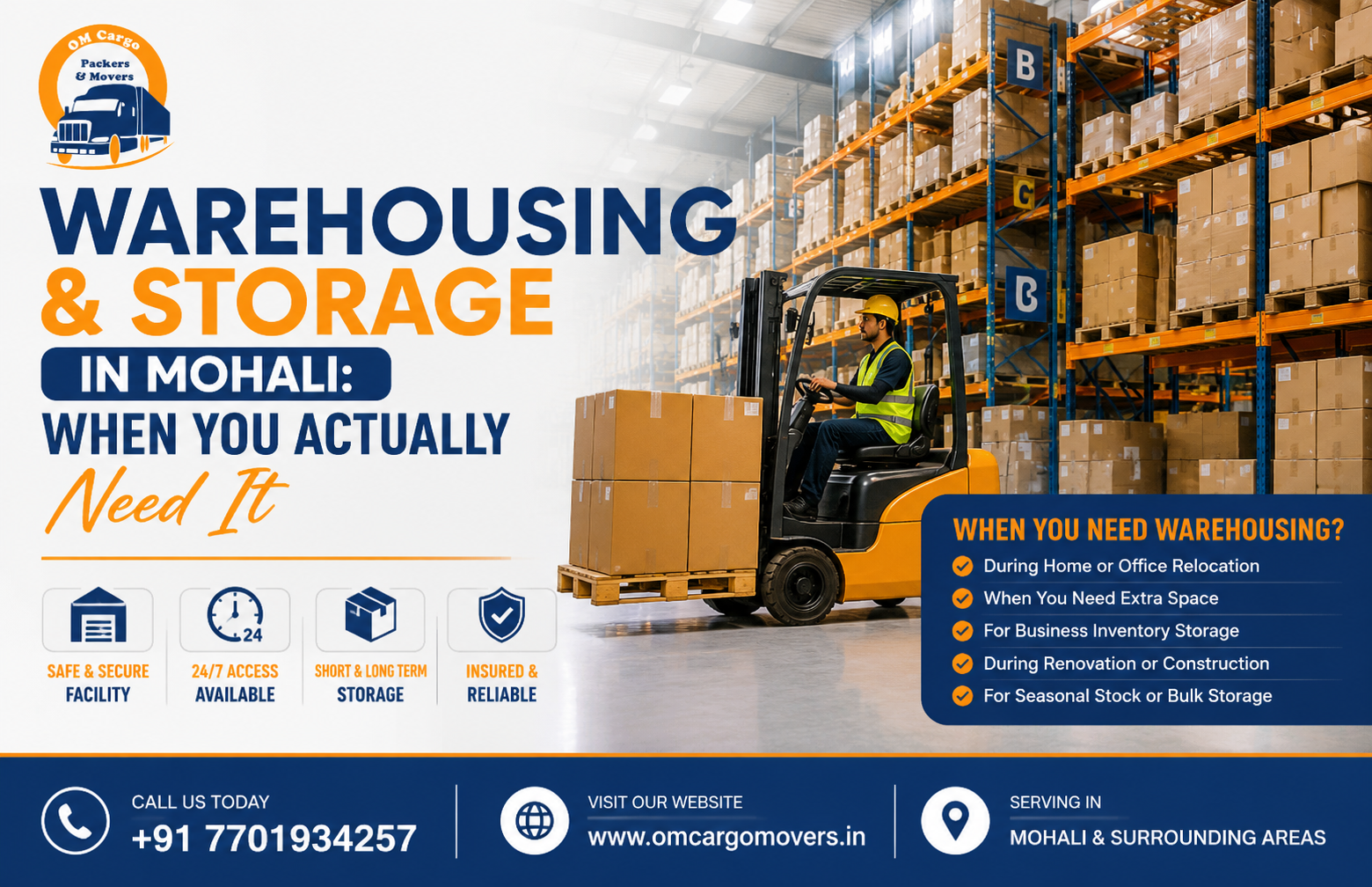
What Warehousing & Storage Actually Means
A warehouse isn’t just an empty room with a lock on it. A proper storage facility gives you a covered, secure space to keep goods for a short stretch or a long one, with reasonable protection from dust, damp, and pests.
Businesses use warehouses to hold inventory, raw material, or stock waiting to be shipped out. Households need them for a simpler reason — too much stuff, not enough space, and a moving date that refuses to line up neatly.
Both needs are legitimate, and both come down to the same three things: a clean facility, honest handling, and someone accountable if something goes wrong.
Why Mohali Has Become a Warehousing Hotspot
Mohali sits right beside Chandigarh, on the road that connects Punjab to Delhi and the rest of North India. That location alone makes it useful for storage — not just for local families but for businesses supplying the wider Tricity.
The industrial belt around Sectors 73 to 75, along with the IT Park area, has pulled in manufacturing units, IT firms, and online sellers over the past decade. Every one of these eventually needs somewhere to hold stock, packaging material, or equipment that won’t fit inside an office.
On the household side, Mohali’s newer sectors are still filling up. Families keep moving between flats, between cities, sometimes between countries, and that churn is exactly why so many packers and movers in Mohali now treat warehousing as a core service instead of an afterthought.
When You Actually Need Warehousing & Storage in Mohali
Here’s a breakdown by situation, since that’s usually more useful than a definition.
1. Your Move-In and Move-Out Dates Don’t Match
This is the single biggest reason people call for storage. Your old house lease ends on the 30th, the new place isn’t ready till the 15th of next month, and somebody has to hold your furniture in between.
Rather than paying two rents or dumping boxes at a relative’s place, your goods go into a warehouse for those two weeks. If you’re already booking home shifting or an office move, this can be arranged in the same conversation.
2. You’re Renovating
Renovation dust and furniture don’t get along well. Sofas, cupboards, and electronics need to be out of the way while flooring or painting work is going on.
Short-term storage keeps furniture away from scratches and paint splashes, and it gives your contractor actual room to work in.
3. You’re Downsizing or Relocating Abroad
Shifting to a smaller home, or moving overseas for work, usually means you can’t carry everything with you right away. Old furniture, seasonal items, documents — none of it needs to travel immediately.
Long-term storage holds these safely until you decide what to do with them, and if the move involves another city entirely, our domestic relocation services can pick things up from there once you’re ready.
4. Your Business Has Overflow Inventory
Shops, small manufacturing units, and online stores rarely get stock in neat, sellable batches. Bulk orders or a supplier’s minimum order quantity can leave you with more inventory than the shop floor can hold.
A warehouse gives that extra stock somewhere to sit, so the storefront doesn’t turn into a storage room by accident.
5. You Sell Online and Need Fulfilment Space
E-commerce sellers around Mohali increasingly need a base to store packaging material and stock close to their courier pickup point. Keeping this separate from home keeps the house sane and keeps the family from tripping over cardboard boxes every morning.
6. Seasonal or One-Off Storage
Diwali decorations, winter quilts, wedding décor — most of it is useful for a few weeks a year and dead weight the rest of the time. Seasonal storage keeps it out of the way without making you throw it out just to free up a cupboard.
7. You’re Also Moving a Vehicle
Sometimes storage overlaps with vehicle transport — a car or bike sitting idle during a long-distance move, waiting to be shipped once you’ve settled in. Our car and bike transportation service handles that side separately, so nothing sits around longer than it has to.
Short-Term vs Long-Term Storage: Which One Fits You
Short-term storage generally covers a few days to a couple of months, and suits renovation gaps or an awkward moving timeline. It’s usually priced by volume and duration, so you pay for what you actually use.
Long-term storage stretches from several months to a year or more, and fits situations like relocating abroad, business inventory cycles, or downsizing where you genuinely don’t know when the goods will be needed again.
Neither is objectively “better.” The right choice depends on your timeline, not on whichever option a website is quietly pushing you toward.
What GST Changed for Warehousing in India
This part rarely gets explained properly, but it’s worth knowing. Before GST arrived in July 2017, companies often kept a small warehouse in nearly every state, mostly to dodge interstate entry taxes rather than for any real operational logic.
GST removed that tax-driven reason for scattered, state-wise warehouses. Businesses could finally pick warehouse locations based on sense — proximity to highways, customers, and suppliers — instead of tax avoidance. Industry studies have linked this shift to a meaningful drop in overall distribution costs and faster movement of goods across state borders.
For a city sitting on a major North India route, that change worked in Mohali’s favour. Fewer, larger, better-located warehouses became the norm, and the Tricity’s connectivity made it a sensible place to be one of them.
What to Check Before You Hand Over Your Goods
Storage sounds simple right up until something goes missing and there’s no paperwork to fall back on. Before committing, run through these basics:
- Is the facility covered and secure? Ask directly instead of assuming.
- Is there a written inventory list? Every item should be logged, not just “packed and forgotten.”
- Is insurance available? Transit and storage insurance cover you if something genuinely goes wrong.
- Is the company GST registered? Ask for the GSTIN before paying anything. A legitimate operator shows it without hesitation.
- Is there a written estimate? A large cash advance with no paperwork is one of the oldest tricks in this industry. Walk away from it.
None of this takes more than a few minutes, and it saves a lot of regret later.
How Om Cargo Movers Handles Warehousing in Mohali
Om Cargo Movers has been packing and moving households and offices across the Chandigarh Tricity since 2010, and warehousing sits alongside relocation as a core service, not a side offering bolted on for the website.
The company is ISO 9001:2015 certified and IBA approved, works under a registered GSTIN, and offers transit insurance on stored goods — the same checklist mentioned above, minus the guesswork. Storage can be arranged alongside packing and transport for moves within Mohali, Chandigarh, Zirakpur, Panchkula, and Derabassi, so goods move from your old home straight into a secure facility without a third party stepping in between.
You can see the full range of warehousing and storage options here, read more moving-related guides on the blog, or get in touch directly for a quote based on your timeline and volume.
Frequently Asked Questions
How much does warehousing cost in Mohali?
It depends on the volume of goods and how long you need storage for. Short-term storage is usually priced by cubic feet or by the room, while long-term storage tends to get quoted monthly.
Is my furniture safe from damage in storage?
A proper facility protects goods from dust, moisture, and pests, and a reputable mover packs items before storing them. Ask specifically about pest control and waterproofing before you sign up.
Can I access my goods while they’re in storage?
Most providers allow this with advance notice, though short-notice storage used purely for a moving gap may have limited access. It’s worth confirming this upfront.
Do I need insurance for stored goods?
It isn’t legally compulsory, but it’s strongly recommended. Insurance is the difference between “inconvenient” and “financially painful” if something goes wrong.
Is warehousing only for businesses?
No. Households use it just as often — during renovations, relocations, or whenever moving dates refuse to line up.
The Bottom Line
Warehousing in Mohali isn’t a luxury service reserved for big businesses. It’s a practical fix for a very ordinary problem — your stuff needs somewhere safe to sit while life sorts itself out, whether that’s for two weeks or two years.
The trick isn’t finding a warehouse. Mohali has plenty. It’s finding one that’s upfront about pricing, serious about security, and willing to put things in writing before you hand over your belongings.